One last trip to the internet in 2009 with The Rough Guide 14
Sunday, April 19, 2026 After the relative success of my last post about what is probably my most-read book ever (The Rough Guide to the Internet 1996), and after a £5 bid that had no competition on eBay, I am back with a dissection of the last edition of this book in 2009. The book is now an ugly shape and format - no longer pocket-sized. Broadband is mainstream, internet calls are possible thanks to Skype, Google is the de facto choice for search, and Twitter is up and running with its 140-character limit.
Getting online in 2009
Surveys in the book estimate 1.5 billion people were using the internet, which is a considerable jump from the 45 million in 1996!
The Rough Guide states you can "squeeze online" with a 486 IBM-compatible PC, but they recommend either a Pentium II 200 MHz or Mac G3, each with a whopping 64MB of RAM. This was also the era of the Wii and PS3 games consoles, each of which could access the internet, with the Wii shipping with the Opera browser - an experience kindly referred to as "not flawless."
Broadband (a term in 2009 meaning anything from 512Kbps to 24Mbps) had arrived, with cable and ADSL becoming the de facto choices - although dial-up still featured prominently. Broadband providers were moving away from unlimited plans and introducing the dreaded data caps. AOL was far from a recommended ISP at this point, and there's a reference to a campaign to collect 1 million of the AOL free trial CDs and dump them at their headquarters; an initiative that ended with approximately 200,000 CDs being delivered back to the doomed AOL for recycling.
Wi-Fi, Bluetooth, and tethering are mentioned. In 2009, the iPhone and BlackBerry were available with 3G connections, which were steadily replacing WAP (referred to as "Worthless Application Protocol" or "Wait and Pay"). BlackBerry is described as "popular with corporate types" - history would prove its popularity wouldn't last with any types, though.
Android isn't mentioned in the book, and I don't think it became "mainstream" until 2010. There's still a sizable section describing how to find internet cafes, net-enabled phone booths, and the now-ubiquitous Wi-Fi hotspots.
One other reflection I had when reading the book was that while mobile internet was becoming prevalent in 2009, we didn't yet have mobile-first web design; I remember many pages being very difficult to navigate on a mobile screen. Overall, in the 17 years since the publication of this book everything has gotten faster, but in 2009 the foundations of how we use the internet (mobile, multiple devices, broadband) were firmly in place.
The Software
Let's do this in order of popularity at the time:
- Internet Explorer: IE8 was the most recent version.
- Safari: described as an excellent browser and, surprisingly for 2009, available for Windows users (support ended in 2012).
- Firefox: 5 years old and described as an "excellent browser" thanks to its extensions and fewer vulnerabilities to harmful scripts.
- Opera: "very fast and worth trying."
- Chrome: described as in its infancy, but Google's browser was on the verge of a meteoric rise that would overtake Internet Explorer in the coming years.
The internet's brutality is perfectly demonstrated by comparing the 1996 Rough Guide, where Netscape Navigator was the "only choice," to the 2009 edition where it's dead, buried, and never mentioned again.
Bookmark websites were fairly popular in 2009, with Delicious mentioned alongside Digg and StumbleUpon. As were browser plug-ins. All of the following are now consigned to the digital dustbin, but they were listed by The Rough Guide as essential in 2009:
- RealPlayer
- Flash Player
- Shockwave Player
- Windows Media Player
I have some good memories of the Flash player, but absolutely nothing to miss about RealPlayer and the dreaded WMV format.
Googling
Yes, in the Rough Guide to the Internet 2009 there is a whole chapter called "Googling," with merely a sub-heading suggesting there are "other ways to search."
Google is described as having the "biggest, freshest database" with the "most relevant results on top," and is further praised: "there's rarely a need to use any search engine other than Google." The kings of the 1999 search scene - AltaVista, Lycos, and Infoseek - are nowhere to be seen. In 2009 you just "Google it." There's even a two-page spread called "A rough guide to Google wizardry," which teaches you how to find synonyms, linking pages, and ask Google to perform calculations and conversions.
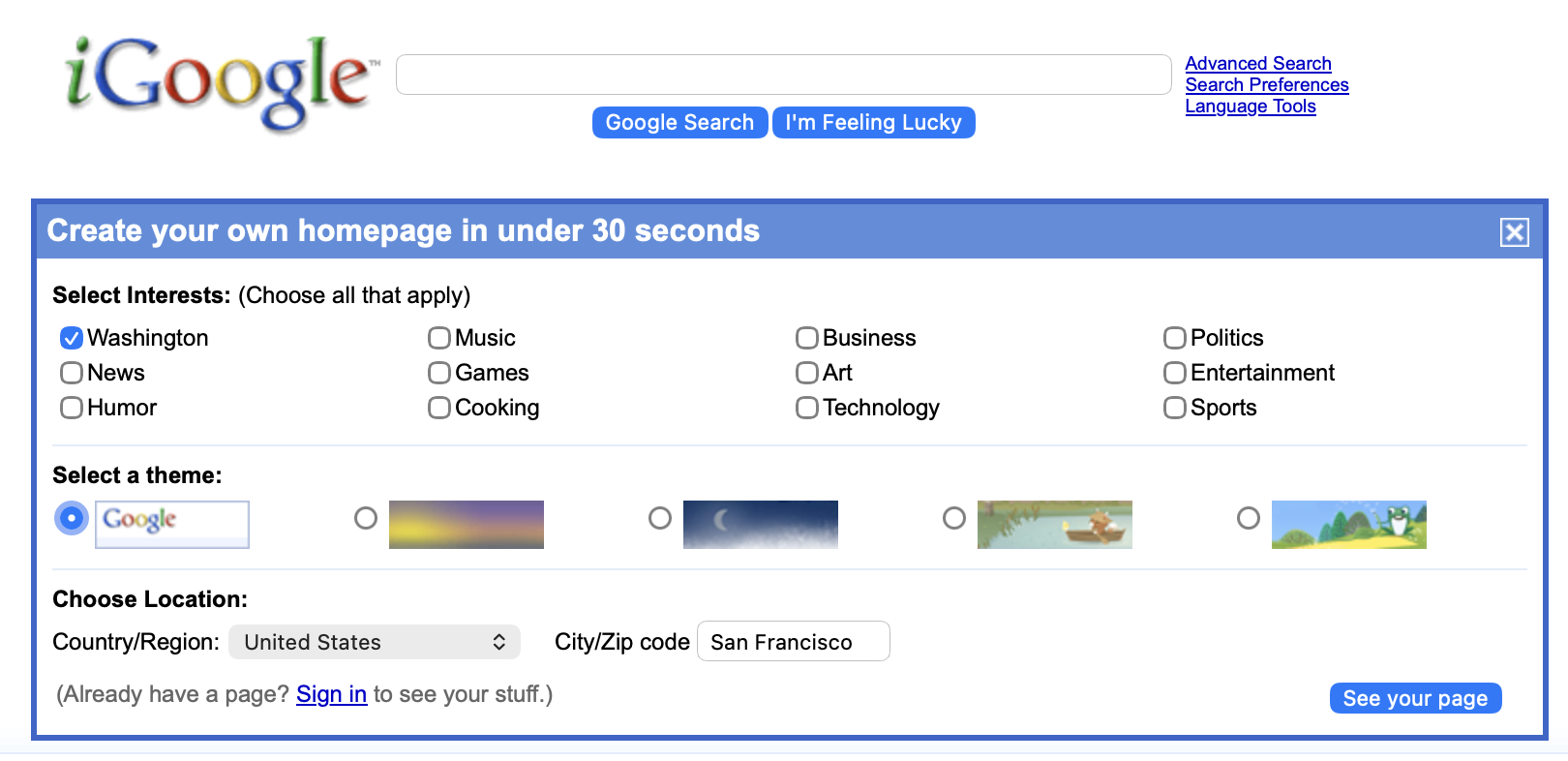
If that's not enough Google, you are directed to Google Alerts (still alive), Google Answers (died in 2006), iGoogle homepage (died with its gadgets in 2013), Google Labs (died in 2011, but has been resurrected again in the era of AI), and more, including some that are still here today like Google Mail and Google Docs.
Email, chat and calls
In 13 years, The Rough Guide's top e-mail pick switched from Hotmail to Gmail. Hotmail is now described as "pretty crummy," partly because accounts left unused for a few weeks were routinely frozen. Yahoo Mail was, like today, on the scene too.
As mentioned earlier, broadband is now the de facto standard, so calls with or without video are more than possible. There was no shortage of options in 2009 with Skype, AOL Instant Messenger (AIM), Windows Live Messenger, or iChat (for Mac users). ICQ gets a small mention, but I believe its death was already approaching.
Two prominent internet icons from 1996 are less prominent by 2009:
- IRC (Internet Relay Chat) is described as an "old corner of the internet."
- Newsgroups are described as a tech whose "heyday has been and gone."
There's still a nice section about acronyms and emoticons though, e.g. the infamous A/S/L for Age, Sex, Location, and ROFL (Roll on the floor laughing), which I still use a lot today. Others, like AOLer, are long gone (and as a Brit, I never really knew them anyway), and emojis have since replaced original emoticons like :-D or X-). I am still a fan of using *asterisks* for emphasis, though.
Shopping
Comparison engines had arrived in 2009 with AddAll (still up and running and looks as basic as in 2009), PriceWatch (the .com consumer-facing site is dead), Kelkoo (still going strong!), and Google Products (this was exposed under the froogle.google.com domain - a perfect example of Googliness, which ended when it became Google Shopping) listed as the main choices.
eBay gets Chapter 13 all to itself. It lists complementary websites like Bizarre Bids and Who Would Buy, but when I checked the Wayback Machine, these sites already looked dead (victims of social media and seller restrictions, I guess) in 2009. I suspect The Rough Guide authors knew their days were numbered, so they didn't try too hard to verify every link.
PayPal (which had already been acquired by eBay in 2002) is, of course, the preferred choice for settling auctions.
Media incl. P2P file sharing
Those broadband connections had plenty to be used for in 2009. Though Napster had been "bludgeoned into submission." KaZaA is described as the "most downloaded program in the history of the Internet," but by 2009 it was crippled due to continuous legal action.
BitTorrent, eDonkey2000, FastTrack, and Gnutella are mentioned, but The Rough Guide stops short of pointing the reader to a reliable source of torrents.
It surprised me that major streaming platforms like BBC iPlayer, Channel 4 on Demand, and Hulu were already up and running in 2009. Where have those 17 years gone? YouTube didn't look as polished as it does today, and notably, it still streamed video using Adobe Flash; it would take a few more years to fully transition to HTML5.
Security
Many of the websites referenced in this edition no longer exist, and some of their domain names have been hijacked to serve malware. I found this out when my ISP (Sunrise in Switzerland) blocked access when navigating to Internet World Stats.
Spyware and phishing are two terms that feature prominently in the book. The Rough Guide prescribes some medicine, much of which is still applicable today:
- Keep your system up to date. I guess this is something Google Chrome largely fixed with its "evergreen browser" approach.
- Don't run dodgy software. I certainly remember receiving .bat and .com attachments in my e-mail from nefarious sources.
- Hide behind a firewall. The free version of ZoneAlarm is recommended, though Windows Defender would soon cannibalise it.
- Scan. McAfee, Norton, or TrendMicro are the commercial recommendations, but AVG Free is described as "perfectly good." Another software that was largely eaten by Windows Defender.
- Consider switching browser & mail program. This was the time for the book to hate on Outlook Express and suggest a switch to the web-based Gmail.
This section ends with omnipresent advice: "Don't get scammed."
Software
Open Source Software (OSS) isn't a term that features in this last edition, although GitHub was up and running in 2009. GitHub's homepage has changed considerably in the years since:

The book mentions Adware, Shareware, Scareware, Donationware, beta versions, and demo versions. I remember being offered a choice of mirror sites when downloading something - a phenomenon that has largely disappeared thanks to Content Delivery Networks (CDNs) like Cloudflare. FTP still gets a mention; in fact, it wasn't until 2021 that browsers like Chrome and Firefox finally removed support for it. Sections like this remind you how quickly we make technology obsolete; for example, there's simply no need for software like Download Accelerator Plus anymore.
Social Networks
In 2009 I don't think Social Networks had total domination, but they were reaching the tipping point. The Rough Guide tracked them by user numbers:
- Facebook (140 million users) - it's listed as the world's second most popular photo sharing site (behind Flickr) and is praised for its "neat and clear" design. Facebook now has 3.2 billion users. It was already number one in the UK and USA back in 2009.
- MySpace (253 million registered users) - still very popular, but The Rough Guide describes one of the problems that would ultimately destroy it: "results are often chaotic and uneasy-on-the-eye."
- Friendster (90 million users) - called the "grandaddy" of the social networking scene, due to it being 8 years old. It would try and live on in Asia, but there would soon be no competing against Facebook.
- Orkut (67 million registered users) - the precursor to the whole Google+ debacle and failure. It seems the original founder is still optimistic about bringing something back.
- Bebo (40 million users) - owned in 2009 by AOL who acquired it for 850 million dollars; it stood for "blog early, blog often." Bebo is now internet history and AOL sold it back to the founders for just 1 million dollars 4 years later.
- LinkedIn (30 million registered users) - acquired by Microsoft in 2016 and now has 1.3 billion users.
- Twitter (5 million registered users) - now called X and owned by Mr Musk. Twitter was in for a wild ride, but in 2009 it was firmly anchored to its 140-character roots (most people contributed by SMS from their "dumbphones"). The Rough Guide accurately predicts that Twitter would "multiply its population very rapidly over the coming years."
There are also mentions of Windows Live Spaces and Yahoo! 360. To be honest, I can't remember either of them, but I guess the play was to bolt social networking onto existing messenger apps - an ill-fated strategy, as Facebook Messenger, Twitter, and WhatsApp would soon destroy their traffic.
Blogs and your own website are in vogue

The term homepage still features alongside blog, which first appeared in 1999. How I wish for a return to this time, when the web felt a bit more personal. In 2009 Blogger, part of Google (still alive!), was the de facto choice to get started. Or you could, much like today, go to WordPress.org and set up your own. There's also a section about setting up your own Podcast.
If you wanted your own homepage, GeoCities is still mentioned in The Rough Guide, but it was about to suffer a swift death, with Yahoo! deleting around 38 million pages by October 2009. The best advice in the book, which endures today, is to register your own domain and choose a host. There was no asking ChatGPT to build your site; instead, you were given the basics of HTML syntax or a tip to visit Mr Site, who promised to give you "everything you need to get a professional dot com website online."
Google Reader (died in 2013) features in the "RSS Feeds" chapter, as do many defunct aggregators like RSS Owl, Blog Bridge, and My Yahoo. There's also a small reference to the "RSS Bunny" - a plastic rabbit that could read your RSS feeds out loud. Thanks to indie hackers, Nabaztag lives on a little today.
Summary
The only Rough Guide I ever owned was the Rough Guide to the Internet 1996. I don't think I missed out on much by not buying the 2009 edition at the time. But I hope you've enjoyed a trip down memory lane. For me a few things stood out:
- There wasn't much need for a Rough Guide to the Internet book in 2009.
- Many of the sites we use today (Facebook, Twitter/X, YouTube, Amazon, Hulu, Gmail, etc.) were already up and running quite successfully in 2009. Of course, others like Instagram, Pinterest, TikTok, and Zoom weren't. I didn't include an obituary section this time, as many of the big sites mentioned are still around - notwithstanding all the social media platforms that Facebook was about to wreak death and destruction on.
- The internet and tech haven't changed that fundamentally since 2009. The iPhone has gotten better, Android has found its market share, the mobile web is faster and has become the priority, but all of this already existed in a rougher form back then.
With AI tools like ChatGPT and Claude on the scene and the "just Google it" mantra under threat, we might be entering a period of massive fundamental shifts. I fully expect the next 17 years to change the internet a lot. The only thing that's for sure is that The Rough Guide to the Internet will not be there to document it.